
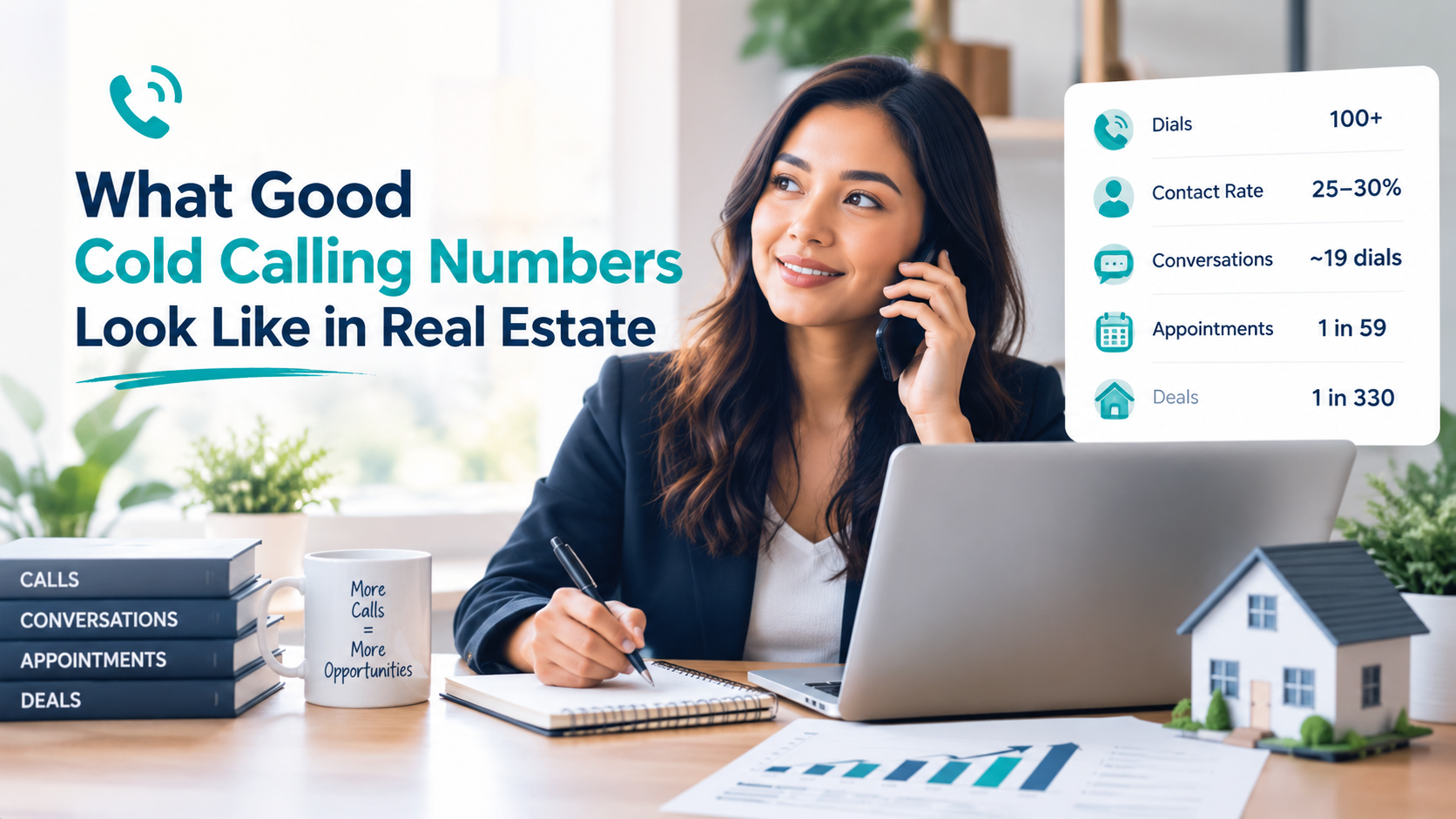
What Good Cold Calling Numbers Look Like in Real Estate
Every real estate agent and investor who picks up the phone wants to know one thing. Am I doing well, or am I wasting my time?
The answer is not always clear. Some days you make 100 calls and talk to nobody. Other days, one call turns into a listing. Without a clear picture of what “normal” looks like, it is easy to quit too early or to keep doing something that is not working.
That is where cold calling benchmarks help. A benchmark is a reference number that shows what usually happens when people do the same activity. It gives you something to measure yourself against.
In this article, we will look at what real research says about cold calling results, which numbers you should track, and how to use those numbers to improve week after week.
Why Benchmarks Matter in Real Estate Prospecting
Cold calling is a numbers activity. You will hear “no” much more often than “yes.” That is normal. The problem is that most callers have no idea how many “no” answers are normal before a “yes” shows up.
Benchmarks help you in three ways:
- They set realistic expectations. When you know it can take hundreds of dials to book one appointment, a slow morning does not feel like failure.
- They show where the problem is. If people answer but never agree to meet, your script may need work. If nobody answers, your list or calling time may be the issue.
- They help you plan. If you know your numbers, you can work backward from your goals. For example, if you want four appointments a month, you can estimate how many hours of calling that takes.
If you have already read our real estate cold calling tips guide, think of this article as the next step. The tips help you have better calls. The benchmarks help you measure them.
The Five Numbers Every Caller Should Track
Before looking at research, it helps to agree on what we are measuring. Many cold calling numbers online are confusing because people measure different things. One person’s “success rate” might mean appointments per dial, while another means appointments per conversation.
Here are the five numbers that matter most:
- Dials. The total number of calls you make, whether someone picks up or not.
- Contact rate. The share of dials where a real person answers. This is sometimes called the connect rate.
- Conversations. Calls where you actually talk with the owner or decision-maker, not just a quick hang-up.
- Appointment rate. The share of conversations, or dials, that turn into a booked meeting, call-back, or property visit. Always note which one you are using.
- Appointment-to-deal rate. How many of those appointments become a listing, a purchase contract, or a closed deal.
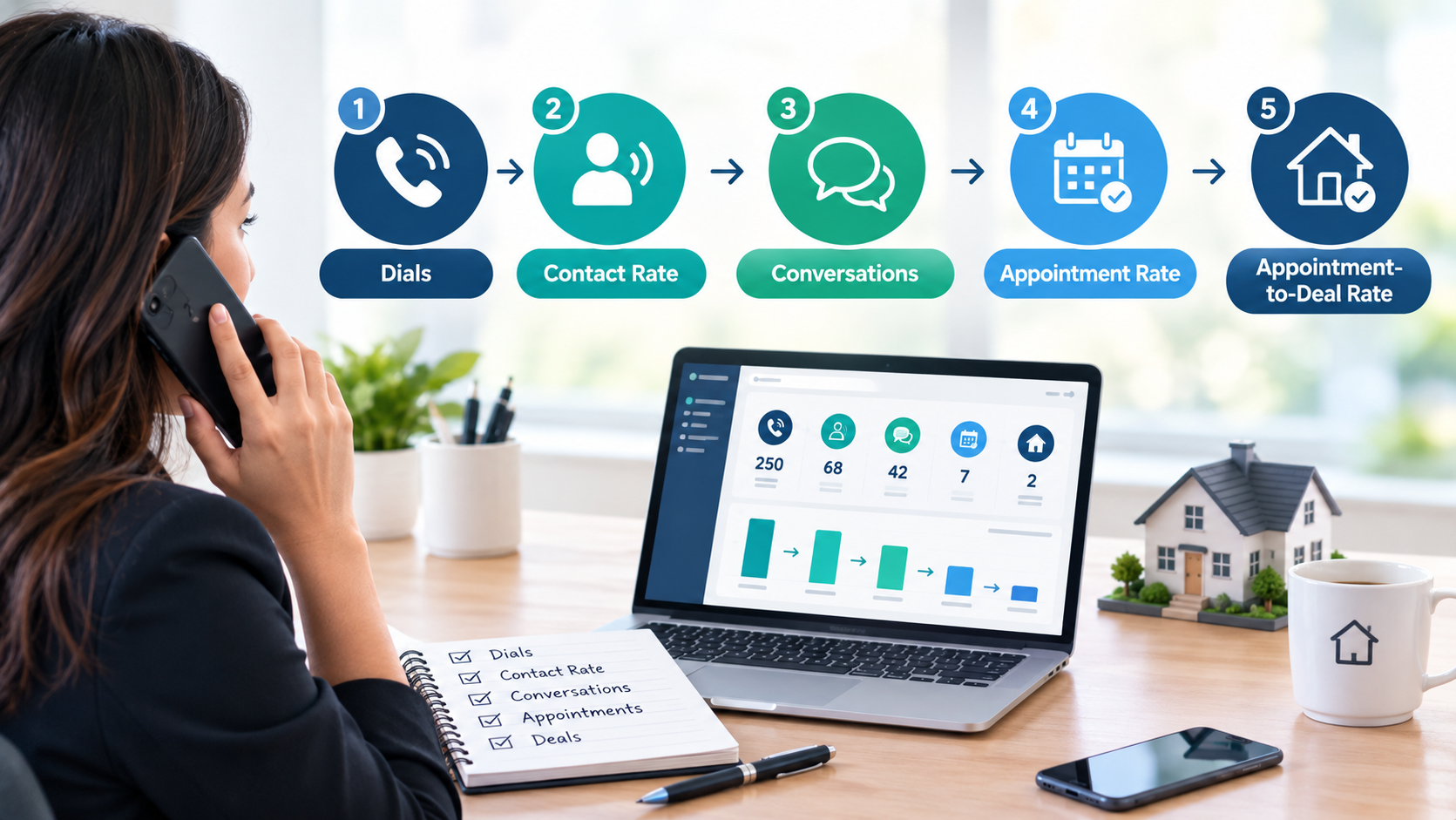
When you track all five, you can see exactly where leads drop off. This is the same idea we covered in our post on KPI tracking for virtual assistants. If you only count dials, you only see effort. If you count each step, you see results.
What the Research Actually Says
There are many cold calling “statistics” online, but a lot of them repeat each other without a clear source. Below are numbers from studies that explain who they measured and how.
The Baylor University real estate study
The best-known real estate cold calling study came from Baylor University’s Keller Center for Research, working with Keller Williams Realty. In November 2011, 50 agents made 6,264 cold calls to random phone numbers in areas they had not marketed to before (Baylor University, Keller Center for Research).
Here is what happened:
- About 28% of calls were answered, 55% were not answered, and 17% reached numbers that no longer worked.
- From the 1,774 answered calls, agents booked 19 appointments and received 11 referrals.
- That works out to about one appointment for every 330 dials, or one appointment or referral for every 209 dials.
- Once someone answered, about 1 in 59 answered calls led to an appointment or referral. When you include people who asked to be called back later, roughly 1 in 10 or 11 answered calls showed some interest.
The researchers estimated that it took about 7.5 hours of calling to get one appointment or referral, and they described that as a fairly strong return for a completely unqualified list (Baylor University).
Two things are important here. First, this list was random. It had no targeting at all. Second, the study is from 2011, so phone habits have changed since then. Still, it gives a useful “worst-case starting point” for real estate.
Fewer people answer unknown numbers today
Phone behavior has shifted a lot. A 2020 Pew Research Center survey found that about eight in ten Americans say they generally do not answer cellphone calls from unknown numbers. Only 19% said they usually pick up. However, 67% said they do not answer but will check a voicemail if one is left (Pew Research Center).
This tells us two things. Answer rates today may be lower than in the Baylor study, and voicemail still matters. A short, clear voicemail is not wasted effort.
Large-scale call data from sales teams
Gong, a sales software company, analyzed more than 300 million cold calls in 2024. Most of these were business-to-business calls, not real estate, but the patterns are still useful. Gong found that an average caller needs about 19 dials to get one conversation, while top-performing callers need only about 8 (Gong Labs).
Gong also found that calling a prospect almost doubled the reply rate to follow-up emails, from 1.81% to 3.44%, even when the call was not answered (Gong Labs). In simple words, a call that goes unanswered can still help your other outreach.
A Simple Benchmark Table for Real Estate Callers
Using the studies above, here is a practical starting point. These are not strict rules. They are reference points to compare your own results against.
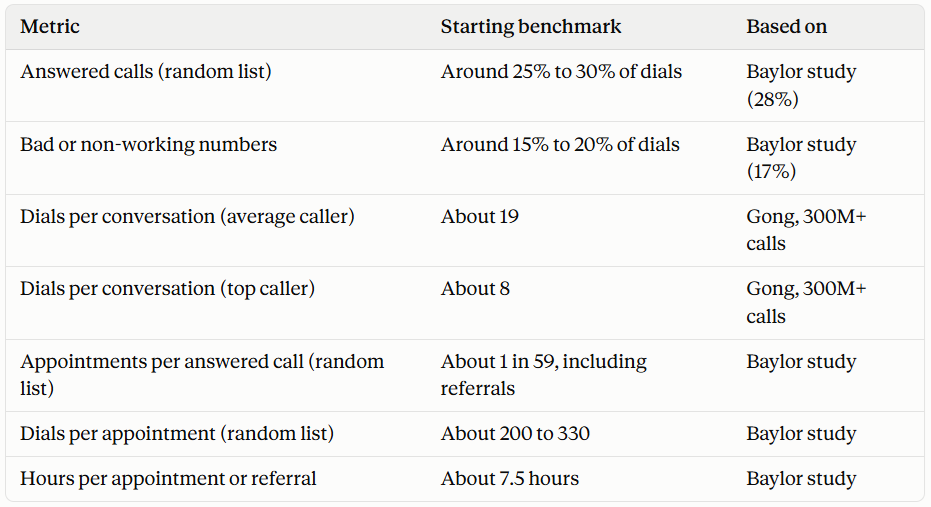
If your numbers are worse than this, look at your list and your script first. If your numbers are better, that is a good sign your targeting is working.
Keep in mind that targeted lists, such as expired listings, for-sale-by-owner homes, or absentee owners, usually perform better than a random list because the people you reach already have a reason to talk. Track those lists separately so you can see the difference in your own data.
Timing Makes a Real Difference
When you call can matter almost as much as how you call. In the Baylor study, calls made between 10 a.m. and 2 p.m. were only 31% of all calls, but they produced 53% of the appointments and referrals. Calls made after 5 p.m. were 42% of all calls but brought in only 21% of the results (Baylor University).
This does not mean evening calls never work. Some homeowners are only free after work. But if most of your calling happens at night and your results are low, try moving some of your calling blocks to late morning and early afternoon. Then compare the numbers after a few weeks.
Your List Is Often the Biggest Problem
In the Baylor study, 72% of calls were very short because nobody answered or the number did not work. That is a lot of time spent on calls that go nowhere.
A clean, well-targeted list can change your benchmarks more than any script. A few simple habits help:
- Remove disconnected numbers right away.
- Update records after every call, including wrong numbers and call-back requests.
- Separate lists by type, such as expireds, FSBOs, and absentee owners.
- Use a good CRM so nothing gets lost. Our guide to the best CRM systems for real estate investors compares popular options.
When your list is clean, your contact rate goes up, and every hour on the phone becomes more productive.
Stay Within the Rules
Good benchmarks mean nothing if your calls break the law. In the United States, the Federal Trade Commission’s Telemarketing Sales Rule says sales calls to consumers can only happen between 8 a.m. and 9 p.m. in the person’s local time (FTC). Callers must also check their lists against the National Do Not Call Registry at least every 31 days and keep their own internal do-not-call list for people who ask not to be called again (FTC).
Some states have stricter rules, so check your local requirements as well. Building compliance into your process protects your business and your reputation.
How to Use Benchmarks Every Week
Benchmarks are most useful when you review them often. Here is a simple weekly routine:
- Record your five numbers at the end of each calling day.
- Add them up every Friday and compare them with the benchmark table.
- Find the weakest step. Is it contact rate, conversations, or appointments?
- Change one thing at a time. Try a new calling window, a cleaner list, or a new opening line.
- Compare again next week to see if that change helped.
Over a few months, you will build your own benchmarks. These will be more useful than any industry average because they reflect your market, your lists, and your style.
If you are still deciding who should handle this work in your business, our article on real estate ISA vs. cold caller roles explains how the two jobs are different.

Turning Benchmarks Into Growth
Cold calling still works in real estate, but it rewards people who are consistent and who measure their results. The research shows that appointments take time and effort, often hundreds of dials. It also shows that timing, list quality, and follow-up can make that effort much more productive.
The hard part for most agents and investors is finding the hours. Between showings, negotiations, and paperwork, daily calling blocks are often the first thing to disappear.
This is where Virtual Staff Labs can help. Our trained real estate virtual assistants and cold callers can make your calls, clean and organize your lists, log every result in your CRM, and send you clear weekly reports on your numbers. You get steady prospecting without giving up your own time.
Want to see how a dedicated caller could fit into your business?
