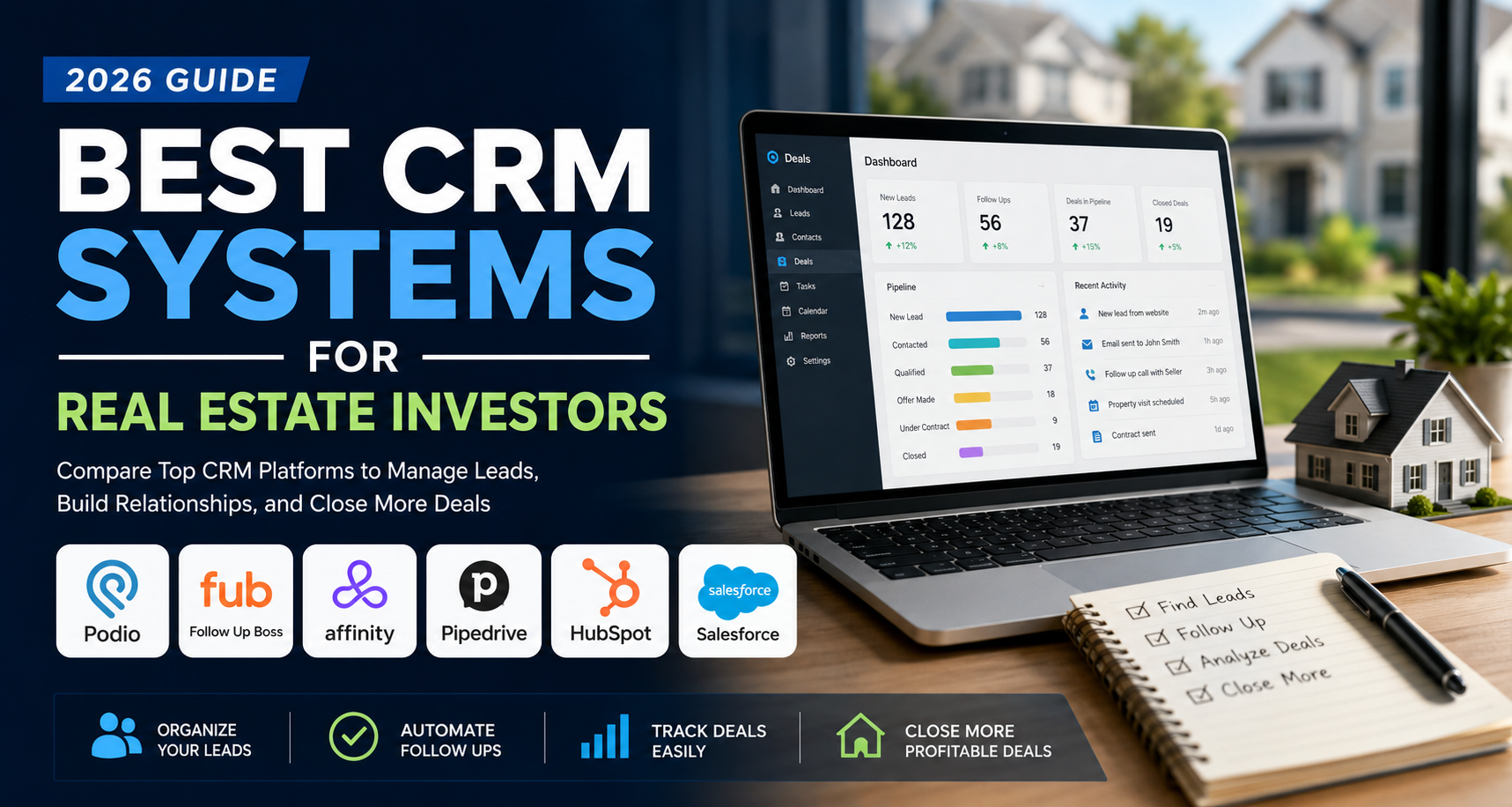
Best CRM Systems for Real Estate Investors
Many real estate investors think a CRM is only for large companies. That is not true.
Whether you are wholesaling properties, flipping homes, or building a rental portfolio, keeping track of leads is one of the most important parts of your business. Every seller inquiry, buyer contact, lender, contractor, and partner should be organized in one place. Without a CRM, it becomes easy to forget follow-ups, lose important information, or miss good investment opportunities.
In this guide, we'll look at some of the best CRM systems for real estate investors in the U.S. We'll compare their strengths, ideal users, and key features so you can choose the right platform for your business.
What is a CRM?
Explain simply.
Include:
- stores contact information
- tracks conversations
- schedules follow-ups
- automates repetitive work
- keeps every deal organized
What Real Estate Investors Should Look for in a CRM
Easy lead management
Can you quickly see where every seller or buyer is in your pipeline?
Automation
Can it automatically remind you to follow up?
Custom fields
Can you track:
- ARV
- repair estimates
- offer price
- property address
- lead source
Mobile access
Useful for driving for dollars, appointments, or property visits.
Integrations
- Phone
- Google Calendar
- Zapier
- Marketing software

Best CRM Systems
1. Podio
Best for:
Custom real estate investing businesses | Growing investing businesses that want flexibility
Podio has remained one of the most popular platforms among wholesalers because it can be customized for almost any workflow. Many investors build custom systems for acquisitions, dispositions, lead management, and transaction tracking.
Pros
- Highly customizable
- Strong automation possibilities
- Large investor community
- Works well with third-party tools
Cons
- Steeper learning curve
- Often requires setup assistance
2. Follow Up Boss (FUB)
Best for:
Teams managing many inbound leads
Follow Up Boss is designed to help businesses respond quickly to new leads and keep communication organized. It supports email, texting, call tracking, lead routing, and automated follow-up, making it especially useful for investors with marketing campaigns generating a high volume of inquiries.
Pros
- Excellent follow-up tools
- Easy pipeline management
- Great reporting
- Team collaboration
Cons
- Higher monthly cost
- Less customizable than Podio
3. Affinity
Best for:
Relationship-driven investors
Affinity focuses on relationship intelligence. Instead of only tracking deals, it automatically captures emails, meetings, and interactions to help users maintain strong professional relationships. This can be valuable for investors working closely with brokers, lenders, private investors, and business partners.
Pros
- Excellent relationship tracking
- Automatic activity logging
- Clean interface
Cons
- Premium pricing
- Better suited for networking than seller lead generation
4. Pipedrive
Best for:
Solo investors and small businesses
Pipedrive offers one of the easiest visual sales pipelines available. Investors can customize stages, automate reminders, track emails, and organize deals without a complicated setup. While it is a general CRM rather than a real estate-specific platform, many investors appreciate its flexibility and ease of use.
Pros
- Very easy to learn
- Excellent visual pipeline
- Affordable
- Good automation
Cons
- Needs customization
- Some advanced features require paid add-ons
5. HubSpot CRM
Best for:
Beginners
Many new investors start with HubSpot because its free version includes contact management, email tracking, and basic automation. As your business grows, you can upgrade for additional marketing and sales tools.
Pros
- Free plan available
- User-friendly
- Good email integration
Cons
- Advanced automation requires paid plans
6. Salesforce
Best for:
Large investment companies
Salesforce is one of the most powerful CRM platforms available. It supports extensive customization, reporting, automation, and integrations. However, it often requires technical knowledge and may be more than small investors need.
Pros
- Extremely powerful
- Highly customizable
- Enterprise-grade reporting
Cons
- Expensive
- Complex setup
Comparison Table
.png)
Which CRM Is Right for You?
If you're just starting:
→ HubSpot
If you're a solo investor:
→ Pipedrive
If you're wholesaling:
→ Podio
If you generate many online leads:
→ Follow Up Boss
If your business depends on investor relationships:
→ Affinity
If you're managing a large company:
→ Salesforce
A CRM Alone Won't Grow Your Business
A CRM helps organize work.
It does not replace:
- consistent follow-up
- lead generation
- relationship building
- good customer service
Many experienced investors say the system matters less than the discipline to use it consistently. A CRM is most effective when every lead has a clear next step and follow-up schedule.
Final Thoughts
The best CRM for real estate investors depends on your business model, team size, and daily workflow.
Some investors need advanced customization, while others simply want an easy way to organize contacts and remember follow-ups. The good news is that most leading CRM platforms offer free trials or demos, making it possible to test different options before committing.
The most important step is choosing a system you will actually use every day. A well-maintained CRM can help you stay organized, improve communication, and reduce missed opportunities as your investment business grows.
How Virtual Staff Labs Can Help
Even the best CRM works only if someone keeps it updated.
Many real estate investors spend valuable time entering data, following up with leads, scheduling appointments, and organizing transactions instead of focusing on finding new deals. A trained virtual assistant can help manage your CRM, respond to inquiries, schedule follow-ups, update property information, and keep your pipeline organized. This allows investors to spend more time negotiating deals and growing their portfolios.
At Virtual Staff Labs, we connect real estate investors with experienced virtual assistants who understand CRM systems, lead management, and day-to-day administrative tasks. Whether you use Podio, Follow Up Boss, Pipedrive, or another platform, the right support can help you get more value from your CRM without adding to your workload.