Real Estate ISA vs. Cold Caller: What's the Difference and Which One Does Your Business Really Need?
In real estate, generating leads is only one part of the sales process. The other challenge is turning those leads into conversations, appointments, and eventually closed deals.
This is why many real estate agents, investors, and brokerages hire support staff to help with lead generation and follow-up. Two of the most common roles are the Real Estate Inside Sales Agent (ISA) and the Cold Caller.
At first glance, these positions may seem very similar. Both spend time on the phone, both talk to potential clients, and both help create opportunities for agents. Because of this, many real estate professionals use the terms interchangeably.
However, an ISA and a Cold Caller are not the same role. Understanding the difference can help you hire the right person, improve your lead conversion process, and avoid spending money on a role that does not match your business needs.
In this guide, we'll compare Real Estate ISAs and Cold Callers, explain what each role does, and help you determine which one is the better fit for your real estate business.
What Is a Real Estate Cold Caller?
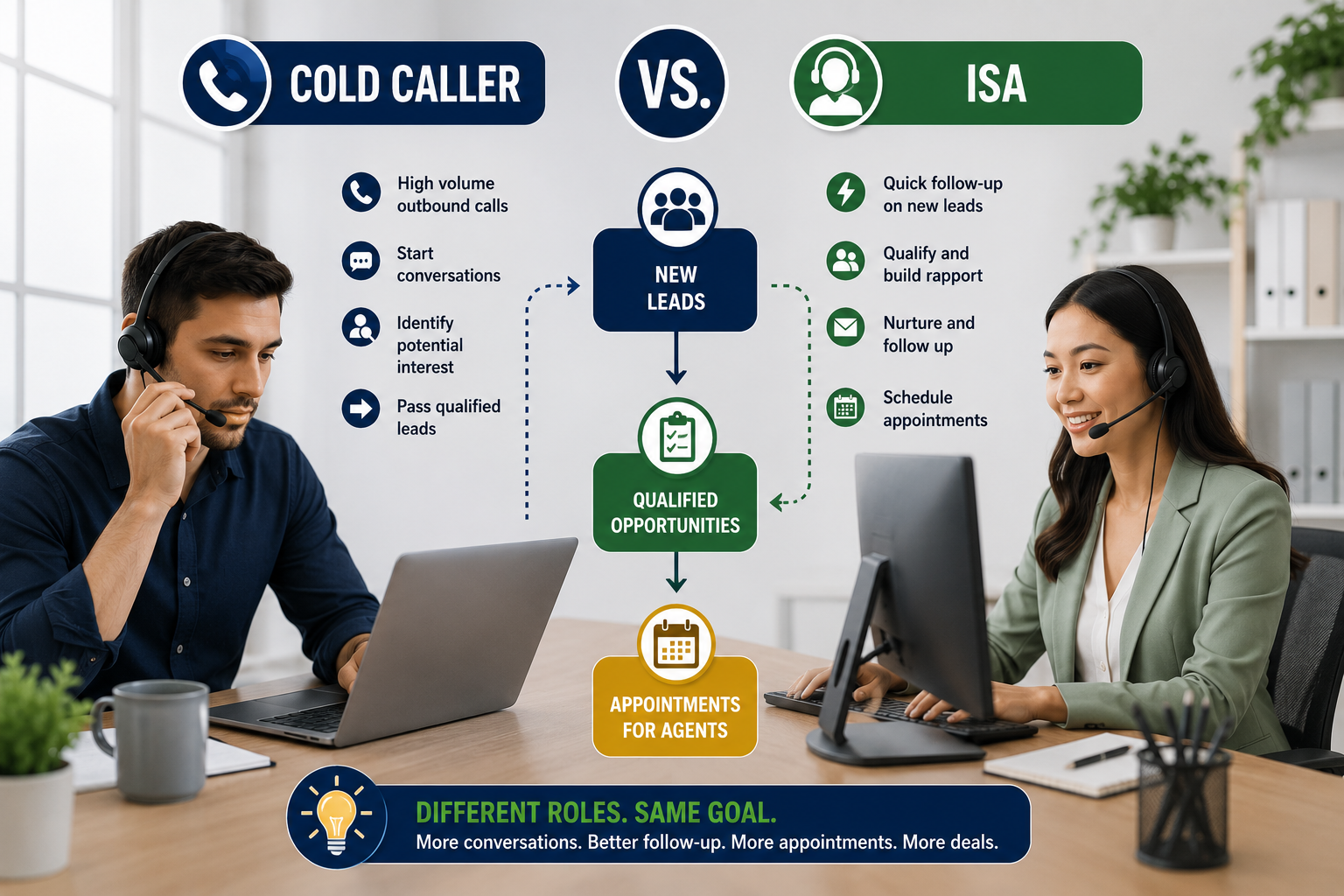
A Real Estate Cold Caller is responsible for reaching out to people who have not recently expressed interest in buying or selling real estate. Their primary goal is to start conversations and identify potential opportunities.
Cold callers typically work with lists of property owners or prospects and make a large number of outbound calls every day. Many of the people they contact are hearing from the caller for the first time.
The objective is simple: find individuals who may have an interest in selling, buying, investing, or discussing real estate opportunities.
Common Lead Sources for Cold Callers
A real estate cold caller may contact:
- For Sale By Owner (FSBO) listings
- Expired listings
- Absentee property owners
- Probate leads
- Distressed property owners
- Investors
- Landowners
- Circle prospecting lists
- Geographic farming lists
Because many of these prospects are unfamiliar with the caller, rejection is a normal part of the job.
Typical Responsibilities of a Cold Caller
A cold caller's daily tasks often include:
- Making outbound calls
- Following a script
- Identifying interested prospects
- Gathering basic information
- Recording call outcomes
- Scheduling appointments when possible
- Passing qualified leads to agents or acquisition managers
Key Performance Indicators (KPIs)
Cold callers are usually measured by activity and lead generation metrics, such as:
- Number of calls made
- Number of conversations
- Contact rate
- Leads generated
- Appointments booked
The focus is often on volume and consistency. A successful cold caller may speak with hundreds of prospects every week to identify a small number of qualified opportunities.
What Is a Real Estate ISA?
ISA stands for Inside Sales Agent.
While cold callers focus primarily on initiating conversations, ISAs are more involved in the lead qualification and nurturing process. An ISA acts as a bridge between lead generation and the real estate agent. Their role is to communicate with leads, determine their level of interest, answer basic questions, build rapport, and schedule appointments for agents.
Unlike cold callers, ISAs frequently work with leads that have already shown some level of interest.
These leads may come from:
- Zillow inquiries
- Website forms
- Facebook ads
- Google ads
- Open house registrations
- Referrals
- CRM databases
- Past clients
An ISA's job is not simply to make calls. Their goal is to move prospects through the sales pipeline until they are ready to meet with an agent.
Typical Responsibilities of an ISA
An ISA may:
- Call new inbound leads
- Respond quickly to inquiries
- Qualify buyers and sellers
- Follow up with old leads
- Send text messages and emails
- Update CRM records
- Schedule appointments
- Nurture long-term prospects
- Coordinate with agents
Key Performance Indicators (KPIs)
ISAs are often measured by:
- Response time
- Contact rate
- Qualified appointments
- Lead conversion rates
- CRM accuracy
- Appointment attendance rates
Because they work deeper in the sales process, ISAs typically focus more on lead quality than call volume.
Real Estate ISA vs. Cold Caller: Side-by-Side Comparison
Although both roles involve communication and lead generation, their responsibilities differ significantly.

The easiest way to understand the difference is this:
Cold callers create opportunities. ISAs develop opportunities.
Both are important, but they contribute to different parts of the sales process.
How Their Daily Workflows Differ
To better understand these roles, let's look at a typical workday.
A Typical Day for a Cold Caller
8:00 AM — Review lead lists
8:30 AM — Begin outbound calling
10:00 AM — Continue prospecting
11:30 AM — Record call outcomes
12:00 PM — Lunch
1:00 PM — Resume outbound calling
3:00 PM — Identify interested prospects
4:00 PM — Send qualified leads to the agent
5:00 PM — End of day
Most of the cold caller's day revolves around prospecting and generating conversations.
A Typical Day for an ISA
8:00 AM — Review new leads received overnight
8:15 AM — Call fresh inquiries
9:00 AM — Respond to text messages and emails
10:00 AM — Follow up with older leads
11:00 AM — Update CRM records
12:00 PM — Lunch
1:00 PM — Call prospects who requested information
2:00 PM — Schedule appointments
3:00 PM — Lead nurturing activities
4:00 PM — Coordinate with agents
5:00 PM — Prepare reports and update pipeline
An ISA typically spends more time building relationships and managing lead progression.
When Should You Hire a Cold Caller?
A cold caller is often the best choice when your business needs more conversations and more opportunities.
Hire a Cold Caller If:
You Need More Seller Leads
If your pipeline is empty and you need new prospects, cold calling can help generate opportunities.
You're a Real Estate Investor
Many investors rely on cold calling to identify motivated sellers and off-market deals.
You're Building a Prospect Database
Cold callers can help create a larger list of contacts for future marketing campaigns.
You Have No Consistent Lead Source
If you are not receiving enough inbound inquiries, outbound prospecting may be necessary.
You Want to Scale Lead Generation
A dedicated cold caller can create more opportunities than an agent trying to prospect between appointments.
Benefits of Hiring a Cold Caller
- Consistent prospecting
- Increased lead volume
- More conversations
- Better pipeline growth
- Improved market coverage
When Should You Hire an ISA?
An ISA is usually the better option when you already have leads but struggle to convert them.
Hire an ISA If:
You Receive Online Leads
If leads are coming from Zillow, Google Ads, Facebook Ads, or your website, an ISA can ensure fast follow-up.
Agents Are Too Busy
Many agents struggle to answer calls while showing properties or attending appointments.
An ISA can prevent opportunities from slipping through the cracks.
Your CRM Contains Old Leads
Many real estate businesses have hundreds or even thousands of leads sitting in their database.
An ISA can reactivate those opportunities.
You Need Better Follow-Up
Many deals are lost because prospects are not contacted consistently.
ISAs specialize in long-term nurturing.
You Want Better Conversion Rates
A strong ISA can improve the percentage of leads that become appointments.
Benefits of Hiring an ISA
- Faster lead response times
- Better lead qualification
- Improved appointment rates
- Stronger client relationships
- More consistent follow-up
Can One Person Do Both Roles?
The short answer is yes. Many small real estate businesses start with one person handling both cold calling and ISA responsibilities.
In the early stages, this can be a cost-effective approach. However, as lead volume increases, combining both roles often becomes challenging.
Cold calling requires:
- High energy
- Constant prospecting
- Large call volumes
- Frequent rejection handling
ISA work requires:
- Relationship building
- Detailed follow-up
- CRM management
- Appointment coordination
- Patience and organization
Because these responsibilities demand different skills and mindsets, performance may suffer when one person tries to do everything.
As a business grows, separating the roles often creates greater efficiency. The cold caller focuses on finding opportunities, while the ISA focuses on converting those opportunities into appointments.
Skills Needed for Each Role
Skills of an Effective Cold Caller
Successful cold callers typically possess:
Confidence: They are comfortable speaking with strangers.
Persistence: Rejection does not discourage them.
Communication Skills: They can quickly explain their purpose and maintain conversations.
Script Discipline: They understand how to follow proven call structures.
Time Management: They remain productive throughout high-volume calling sessions.
Skills of an Effective ISA
Strong ISAs often excel in:
Active Listening: They understand client needs and motivations.
Relationship Building: They establish trust with prospects.
Organization: They manage multiple leads at different stages.
CRM Experience: They maintain accurate records and follow-up schedules.
Objection Handling: They can address concerns and keep conversations moving forward.
Common Mistakes Real Estate Teams Make
Many real estate businesses struggle not because of the people they hire, but because they misunderstand the role.
Mistake #1: Expecting an ISA to Function Like a High-Volume Cold Caller
An ISA is not designed to make hundreds of calls every day. Their focus is quality conversations and lead progression.
Mistake #2: Using a Cold Caller for Long-Term Lead Nurturing
Cold callers excel at generating opportunities, not managing months-long follow-up sequences.
Mistake #3: Having No CRM System
Without proper lead tracking, opportunities can easily be lost.
Mistake #4: Failing to Provide Scripts
Even experienced team members benefit from structured call frameworks.
Mistake #5: Measuring the Wrong KPIs
Different roles require different performance metrics. Measuring an ISA solely on call volume may not accurately reflect their contribution.
Mistake #6: Expecting Immediate Results
Both cold calling and ISA programs require consistency and time to produce meaningful outcomes.
Which Role Delivers Better ROI?
This is one of the most common questions among real estate professionals. The reality is that neither role is universally better. The answer depends on your current business challenge.
Cold Caller ROI
A cold caller may provide stronger returns when:
- You need more leads
- Your pipeline is thin
- You focus on off-market opportunities
- You need more prospecting activity
ISA ROI
An ISA may provide stronger returns when:
- You already have leads
- Agents are overwhelmed
- Follow-up is inconsistent
- Lead conversion rates are low
Think of it this way:
If your problem is a lack of opportunities, a cold caller may solve it.
If your problem is converting opportunities into appointments, an ISA may provide more value.
Final Thoughts
The debate between a Real Estate ISA and a Cold Caller is not really about which role is better. It's about identifying where your sales process needs support. If your business struggles to generate conversations, a cold caller may be the right choice. If you already have leads but need help qualifying and nurturing them, an ISA may be the better investment.
Many successful real estate teams eventually use both roles. Cold callers focus on creating opportunities, while ISAs ensure those opportunities receive consistent follow-up and move through the sales pipeline. Together, they create a more efficient system that allows agents to spend less time prospecting and more time meeting clients, showing properties, negotiating deals, and closing transactions.
As your real estate business grows, having the right people in the right roles becomes increasingly important. Whether you need support with cold calling, lead qualification, appointment setting, or ongoing follow-up, building a reliable team can help create consistency and improve results over time.
Virtual Staff Labs works with real estate professionals by connecting them with trained remote talent who can support day-to-day sales and lead generation activities. From cold callers to inside sales support and administrative assistance, the goal is simple: help real estate teams stay productive, responsive, and focused on serving clients while growing their business.