

How Much a Cold Caller Really Costs and What You Get for the Money
If you are thinking about hiring someone to make cold calls for your business, the first question is usually simple. How much will this cost me?
The honest answer is that it depends. A cold caller can be a full-time employee, a part-time freelancer, an agency, or a dedicated virtual assistant. Each option has a different price, and each one comes with costs that are easy to miss.
In this article, we will break down what a cold caller costs in real numbers. We will cover the hidden costs that many business owners forget, and we will show how to judge whether a caller is worth the money.
Why the Price Tag Is Only Part of the Story
Most people compare cold callers by hourly rate. That is a good start, but it does not tell you the full cost.
A $15 per hour caller who books two appointments a week may cost you more per appointment than a $25 per hour caller who books six. A cheap caller who needs constant supervision may also eat up hours of your own time.
So when you look at cost, think about three things:
- What you pay the caller. This is the wage, salary, or monthly fee.
- What it costs to support the caller. This includes tools, phone lines, lead lists, training, and management time.
- What you get back. This means the conversations, appointments, and deals the caller produces.
Let’s look at each part.
Option 1: Hiring an In-House Cold Caller
Hiring a local employee gives you the most control. The caller works on your schedule, follows your rules, and becomes part of your team. It is also usually the most expensive option.
The wage
The U.S. Bureau of Labor Statistics groups cold callers under the “Telemarketers” job category. In its May 2023 data, the median pay for telemarketers was $16.58 per hour. The lower 10% earned around $11.74 per hour, and the top 10% earned about $23.90 per hour (U.S. Bureau of Labor Statistics).
For a full-time caller working 40 hours a week, the median wage works out to roughly $34,500 a year before anything else is added. Pay is often higher in big cities and for callers with real estate or sales experience. Many callers also earn bonuses or commissions on top of their base pay.
The benefits and payroll costs
Wages are not the only thing employers pay. Benefits and required payroll costs add a lot more. According to the BLS, benefits made up 31.5% of total compensation costs for full-time private industry workers in June 2026 (U.S. Bureau of Labor Statistics). This includes things like paid leave, health insurance, retirement plans, and legally required costs such as Social Security and unemployment insurance.
If you apply that same share to a $16.58 hourly wage, the true cost to the employer comes closer to $24 per hour. For a full-time caller, that is roughly $50,000 a year, or about $4,200 a month. This is a rough estimate, but it shows how quickly the real cost grows beyond the hourly wage.
The hiring and training costs
You also pay to find and train the right person. That includes job ads, interview time, background checks, and the weeks it takes a new caller to get comfortable with your scripts and market. If the caller leaves after a few months, you pay many of these costs again.
Cold calling has a reputation for high turnover because the work involves a lot of rejection. Planning for that risk is part of budgeting for an in-house hire.
Option 2: Hiring a Freelance Cold Caller
Freelancers are popular with small teams and solo agents who want help without hiring a full employee. You usually pay by the hour or by the project, and you do not pay benefits or payroll taxes.
Freelance rates vary a lot. They depend on the caller’s location, experience, and English skills. Some freelancers charge low rates but have little training. Others charge more because they bring proven scripts and real estate experience.
The main trade-offs with freelancers are:
- Less consistency. A freelancer may work for several clients and may not always be available when you need them.
- More management on your side. You will usually handle training, quality checks, and replacing the caller if things do not work out.
- Uncertain quality. Without a screening process, it can take a few tries to find the right person.
Freelancers can work well for short projects or testing a new list. For steady, long-term prospecting, many business owners prefer a more stable setup.
Option 3: Using a Cold Calling Agency
Some agencies handle cold calling as a full service. They provide the callers, the dialing software, and the reporting. Pricing models differ. Some charge a monthly retainer, some charge per hour of calling, and some charge per appointment booked.
Agencies can be a fast way to get started because they already have systems in place. However, you often share callers with other clients, and you may have less control over how your brand sounds on the phone. Pay-per-appointment models can also lead to lower-quality appointments if the agency is rewarded for volume instead of fit.
Option 4: Hiring a Dedicated Virtual Cold Caller
A dedicated virtual cold caller works only for your business, usually through a staffing company. You get one trained person who learns your market, your scripts, and your CRM, without the cost of a local employee.
This option sits between a freelancer and an in-house hire. You get the consistency of a dedicated team member, and the staffing company usually handles recruiting, screening, and replacement if the fit is not right.
If you are weighing offshore support against local hires, our guide on offshore vs. local assistants goes deeper into the pros and cons of each.
The Hidden Costs Most Business Owners Forget
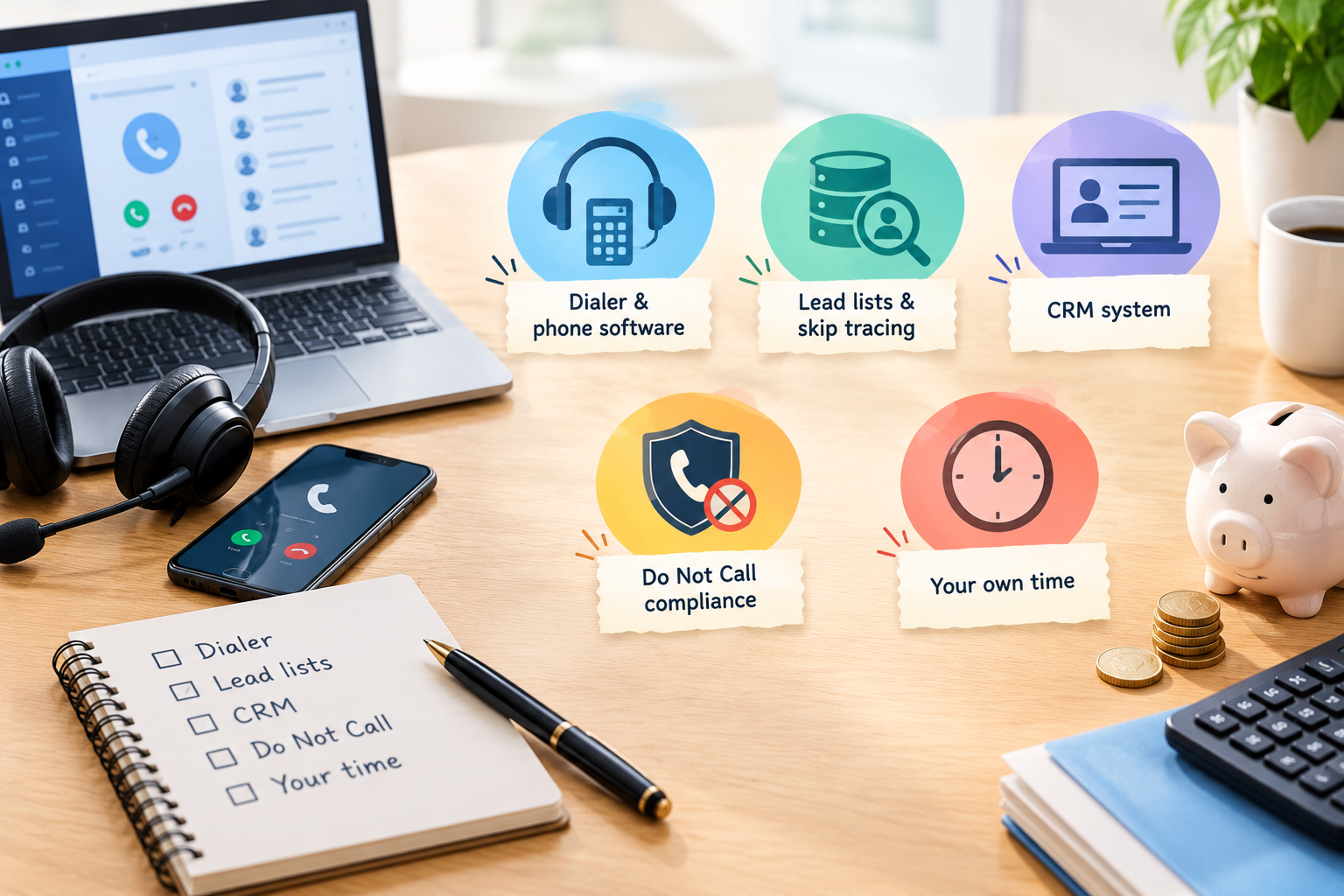
No matter which option you choose, some costs come with the job of cold calling itself. Make sure to include these in your budget.
Dialer and phone software
Most callers use a dialer to make calls faster and log results. These tools usually charge a monthly fee per user. Some also charge for phone numbers, call recording, or extra minutes.
Lead lists and skip tracing
A caller needs good numbers to call. Many real estate businesses pay for lead lists, data services, or skip tracing to find owner phone numbers. Clean data costs money, but bad data costs more in wasted hours.
A CRM system
Every call needs to be logged so follow-ups do not get lost. If you do not already have a CRM, this is another monthly cost.
Do Not Call compliance
If your callers contact consumers in the United States, you need access to the National Do Not Call Registry. Starting October 1, 2026, the FTC charges $85 per area code each year, with the first five area codes free (Federal Trade Commission). If you call across many markets, this fee can add up.
Your own time
This is the cost people forget most often. Writing scripts, training a caller, listening to calls, and reviewing reports all take time away from closing deals. If you are the one managing the caller, your time is part of the price.
How to Measure Whether a Cold Caller Is Worth It
The best way to judge cost is to look at cost per appointment instead of cost per hour.
Here is a simple way to think about it. A well-known Baylor University study found that real estate agents calling a random list needed about 7.5 hours of calling to get one appointment or referral (Baylor University, Keller Center for Research).
Now apply that to your own costs. If an in-house caller costs you about $24 per hour with benefits, 7.5 hours of calling would cost about $180 in labor for each appointment or referral. That does not include tools, lists, or your own time. A targeted list and a skilled caller can bring that number down a lot. A poor list and an untrained caller can push it much higher.
To track this in your own business, measure:
- Total monthly cost of the caller, including tools and lists.
- Number of appointments booked that month.
- Cost per appointment, which is total cost divided by appointments.
- Appointments that turn into deals, so you can see the true return.
Our post on KPI tracking for virtual assistants explains how to set up simple reports so you always know what you are getting for your money.
Tips to Get More Value From Your Cold Caller
Whatever you spend, a few habits help you get more out of it:
- Start with clean lists. Remove bad numbers and old records before the caller starts.
- Give clear scripts and goals. A caller who knows what a good call looks like will perform faster.
- Onboard properly. The first few weeks shape everything that follows. Our guide on how to onboard a new virtual assistant can help.
- Pick the right role. Some businesses need a pure cold caller, while others need someone who also follows up and nurtures leads. Our article on real estate ISA vs. cold caller explains the difference.
- Review results every week. Small changes in timing, scripts, or lists can make a big difference over time.

Getting the Most From Every Dollar
A cold caller is an investment, not just an expense. The cheapest option is not always the best value, and the most expensive option is not always worth it. What matters is how much you pay for each real conversation and each booked appointment.
For many real estate agents, investors, and growing businesses, a dedicated virtual cold caller offers a strong balance. You get a trained caller who works only for you, without the full cost of a local employee.
At Virtual Staff Labs, our dedicated, trained cold callers start at $1,450 per month (Virtual Staff Labs Pricing). That includes proven scripts and training, quality control and supervision, a dedicated client success manager, and a perfect-fit guarantee. Your caller works in your time zone, so they are on the phone when your prospects are most likely to answer.
Want to find out what a dedicated cold caller could do for your pipeline?
