

Offshore vs Local Assistant: Which One Is Right for Your Business?
At some point, every growing business hits the same wall. The inbox is full, the calendar is a mess, and the owner is spending hours on tasks that someone else could do. The answer is usually clear: hire an assistant. The harder question is where that assistant should come from.
Today, you have two main paths. You can hire a local assistant who lives in your city or country, or you can hire an offshore assistant who works remotely from another country. Both options can work very well. Both also come with trade-offs that are easy to miss if you only compare hourly rates.
In this guide, we break down the offshore vs local assistant decision in plain terms. We look at cost, time zones, communication, skills, data security, and day-to-day management. By the end, you should have a clear idea of which option fits your business, or whether a mix of both makes the most sense.
What Is the Difference Between an Offshore and a Local Assistant?
A local assistant lives in the same country as your business. They might work in your office, from home, or in a hybrid setup. Because they are nearby, they can come in for meetings, run physical errands, or handle paperwork in person. In the U.S., a local assistant is usually hired as a W-2 employee or as a 1099 contractor.
An offshore assistant lives and works in another country and supports your business remotely. Most offshore assistants are virtual assistants (VAs) who use email, chat, video calls, and cloud tools to get work done. Popular offshore hiring locations include the Philippines, Latin America, and parts of Eastern Europe. The Philippines is one of the biggest, with its IT and business process management industry reporting about $40 billion in export revenue and 1.9 million workers in 2025.
It helps to know that "remote" and "offshore" are not the same thing. A local assistant can also work remotely. The real difference is location and labor market, and that difference affects cost, schedule, and management. If you are still deciding whether you need a remote assistant at all, our guide on Virtual Assistant vs In-House Assistant is a good place to start.

1. Cost: The Biggest Gap Between the Two
For most business owners, cost is the first thing they compare, and it is where the difference is largest.
According to the U.S. Bureau of Labor Statistics (BLS), the median yearly wage for secretaries and administrative assistants was $48,310 in May 2025. But salary is only part of the bill. BLS data from June 2026 shows that benefits make up about 30% of what private employers spend on each worker. That includes health insurance, paid leave, and legally required costs like Social Security and unemployment insurance.
If you do the math, a local assistant earning the median wage can cost a business close to $69,000 a year once benefits are included. That estimate does not yet count recruiting fees, office space, equipment, software licenses, or the time you spend hiring and training. In high-cost cities, the number is often higher.
An offshore assistant usually costs much less because wages and living costs are lower in their home country. When you hire through a staffing company, the monthly fee often includes recruiting, payroll, and ongoing support, so there are fewer hidden costs. That said, the cheapest option is not always the best value. A very low rate can mean weak screening, poor English, or high turnover, which costs you more in the long run.
The takeaway: Compare the total cost of each option, not just the hourly rate. You can see how one staffing model structures this on our pricing page.
2. Time Zones and Availability
A local assistant works during your business hours by default. If a client calls at 2 p.m., your assistant is awake and ready. This makes local hiring simple for roles that need constant, real-time contact.
With an offshore assistant, time zones take more planning. For example, the Philippines is 12 hours ahead of New York during daylight saving time and 13 hours ahead in winter. That sounds like a problem, but many offshore assistants are used to working night shifts so they can match U.S. hours. This is very common in the outsourcing industry.
The time difference can even become an advantage. Some businesses ask their offshore assistant to work outside U.S. hours on purpose. The assistant clears the inbox, updates reports, or prepares documents overnight, so everything is ready when the owner starts work in the morning.
The takeaway: If you need someone during your working day, make sure your offshore assistant agrees to your schedule before you hire. If overnight work helps you, the time gap can speed things up.
3. Communication, Language, and Culture
A local assistant shares your language, slang, and business culture. They understand local holidays, customer expectations, and small details like how to greet a client on the phone. For customer-facing roles in niche local markets, this can matter a lot.
Offshore assistants can also communicate very well, but quality varies from person to person and country to country. In the Philippines, for example, English is widely used in schools, business, and government, which is one reason the country became a leading outsourcing destination. Still, accent, writing style, and cultural habits can differ from what you are used to.
The good news is that most communication issues are about process, not people. Clear instructions, written guides, and regular check-ins solve most problems. If you are new to this, our guide on how to create SOPs for your virtual assistant shows you how to write instructions that anyone can follow.
The takeaway: Test communication skills during the hiring process with a live call and a short writing task. Do not rely on a resume alone.
4. Talent Pool and Skills
When you hire locally, you can only choose from people who live within driving distance, or at least within your country. In a tight job market, good candidates may be hard to find, and they may already have several offers.
Offshore hiring opens a much bigger talent pool. Many offshore assistants have college degrees and years of experience supporting foreign clients. Some specialize in areas like real estate, healthcare admin, bookkeeping, or e-commerce. This means you can often find someone who already knows your tools, such as a CRM, a scheduling system, or an accounting platform.
Offshore assistants are also moving into more skilled work. The outsourcing industry is investing heavily in training, including AI tools, so assistants can take on higher-value tasks. You can read more about this trend in our article on the growing demand for AI-trained virtual assistants.
The takeaway: A wider talent pool gives you more choice, but you still need a strong screening process to find the right person.
5. Data Security, Compliance, and Legal Matters
Security is a fair concern with any hire, but it feels bigger when your assistant is in another country.
With a local assistant, you work under one set of laws. You know how to write an employment contract, and you can take legal action more easily if something goes wrong. On the other hand, hiring locally also means handling payroll taxes, overtime rules, and the risk of classifying a worker the wrong way as a contractor.
With an offshore assistant, your business is still responsible for protecting data under U.S. rules, such as HIPAA for healthcare practices. Some countries also have their own privacy laws. In practice, the biggest risks come from weak habits, not from geography. Shared passwords, personal devices, and unclear access rules cause most problems.
A few simple steps lower the risk a lot:
- Have every assistant sign a non-disclosure agreement (NDA).
- Give access only to the tools and files they need.
- Use a password manager instead of sharing logins by email or chat.
- Keep files in secure cloud platforms, not on personal computers.
For more practical advice, see our post on managing passwords with virtual staff.
The takeaway: Good security is about systems. Put the right rules in place, and offshore work can be just as safe as local work.
6. Management, Reliability, and In-Person Tasks
Managing a local assistant can feel easier at first. You can walk over to their desk, see their work, and fix small problems quickly. If your role needs someone to greet visitors, sort mail, or pick up supplies, a local assistant is the only real option.
Managing an offshore assistant takes a bit more structure. You will rely on tools like Slack, Asana, Google Workspace, and time-tracking apps. You also need clear goals so you can measure results instead of watching hours. Our guide on KPI tracking for virtual assistants explains how to set simple, useful targets.
Reliability depends on how you hire. Freelancers found on job boards may disappear or take on too many clients at once. Assistants placed through a reputable staffing company tend to be more stable because the company handles screening, backup candidates, and support. If an assistant leaves, a good staffing partner can replace them quickly, so your work does not stop.
The takeaway: Offshore assistants need clear systems. Once those systems are in place, many businesses find remote management just as easy as managing someone in the office.
Offshore vs Local Assistant: Quick Comparison
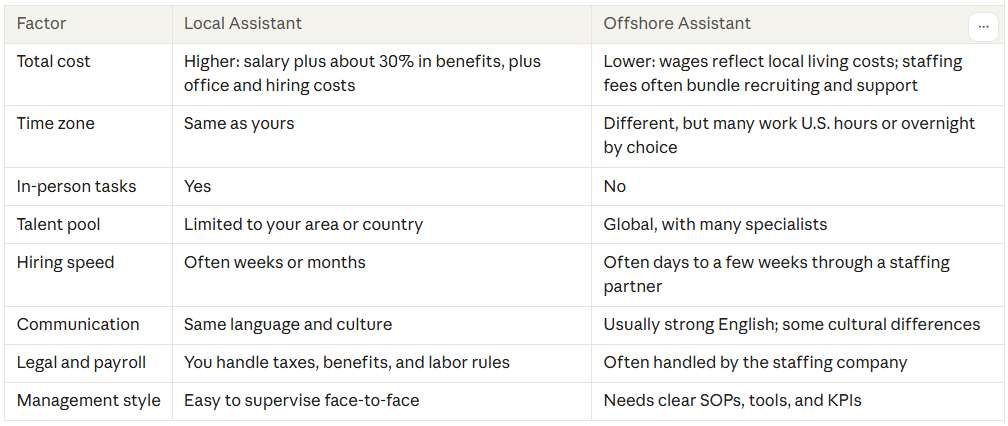
When Should You Choose Each Option?
There is no single right answer. The best choice depends on the work you need done.
Choose a local assistant if:
- The role needs someone in the office, at events, or out running errands.
- You work in a market where deep local knowledge is essential.
- Your budget can support a full salary, benefits, and office costs.
Choose an offshore assistant if:
- Most of the work happens on a computer: email, calendars, data entry, research, CRM updates, social media, or follow-up calls.
- You want to lower labor costs without cutting the quality of support.
- You need to hire quickly or scale your team up and down with less risk.
Consider a hybrid team if:
Many businesses end up using both. A local office manager handles the in-person work, while one or more offshore assistants take care of admin, lead follow-up, and back-office tasks. This setup keeps a local face for clients and frees your local staff to focus on work that truly needs them. If you are not sure which tasks can move offshore, start with our list of 25 tasks to delegate to a virtual assistant.
Tips for Hiring the Right Assistant (Local or Offshore)
Whichever path you choose, these steps will help you avoid common hiring mistakes:
- Write down the tasks first. List what you want to hand off and how often each task happens. This tells you if the role is full-time, part-time, or remote-friendly.
- Define success. Decide how you will measure good work, such as response time, leads contacted, or tasks completed each week.
- Test real skills. Give candidates a short paid task that looks like the actual job. Ask the right questions too; our list of 10 must-ask questions for virtual assistant interviews can help.
- Plan the first 30 days. A clear onboarding plan makes a new hire productive much faster. See how to onboard a new virtual assistant for long-term success.
- Check the backup plan. Ask what happens if the person gets sick, quits, or is not a good fit. A replacement guarantee is a big plus.
Final Thoughts: Offshore or Local?
The offshore vs local assistant choice is not about which one is "better." It is about fit. Local assistants shine when the work is physical, face-to-face, or tied to a local market. Offshore assistants shine when the work is digital, repeatable, and you want strong support at a lower total cost. Many growing businesses get the best results by combining the two.
If offshore support sounds like the right fit, the next step is finding someone you can trust. That is where a staffing partner makes the process easier. Virtual Staff Labs is a U.S.-based staffing company that connects businesses with vetted, U.S.-managed virtual talent. The team screens every candidate for skills, English fluency, and culture fit, then matches them to your specific role, whether that is executive support, real estate, medical admin, or customer service.
Most placements take about 7 to 14 days. Assistants work on your time zone, sign NDAs, and come with ongoing support. If the match is not right within the first 30 days, Virtual Staff Labs will find a replacement at no extra cost. You get the savings of offshore hiring without the guesswork.
Want to see if an offshore assistant makes sense for your business? Book a Discovery Call with Virtual Staff Labs, and we will help you map out the right role, schedule, and skills for your team.
Frequently Asked Questions
Is an offshore assistant cheaper than a local assistant?
In most cases, yes. A local assistant's total cost includes salary, benefits, taxes, and office expenses. An offshore assistant's wages reflect lower living costs, and staffing fees often include recruiting and support.
Can an offshore assistant work U.S. business hours?
Yes. Many offshore assistants, especially in the Philippines, regularly work night shifts to match U.S. time zones.
What tasks are best for an offshore assistant?
Computer-based tasks work best. Examples include inbox and calendar management, data entry, CRM updates, lead follow-up, customer support, bookkeeping support, and social media.
Is it safe to share business data with an offshore assistant?
It can be, if you use NDAs, limit access, use a password manager, and store files in secure cloud tools.
Should I hire a freelancer or use a staffing company?
Freelancers can be cheaper upfront, but you handle screening, contracts, and replacements yourself. A staffing company takes care of those steps and usually offers backup if the hire does not work out.
