
Virtual Assistants for Medical Practices: How They Can Support Your Team
Running a medical practice takes more than providing quality patient care. Doctors, nurses, and clinical staff also have to deal with scheduling, phone calls, paperwork, patient follow-ups, billing tasks, records, and many other administrative responsibilities.
As a practice grows, these tasks can become difficult to manage. A busy front desk may have several calls waiting while staff are also checking in patients, answering messages, and updating records. This is one reason more medical practices are looking at virtual assistants for medical practices.
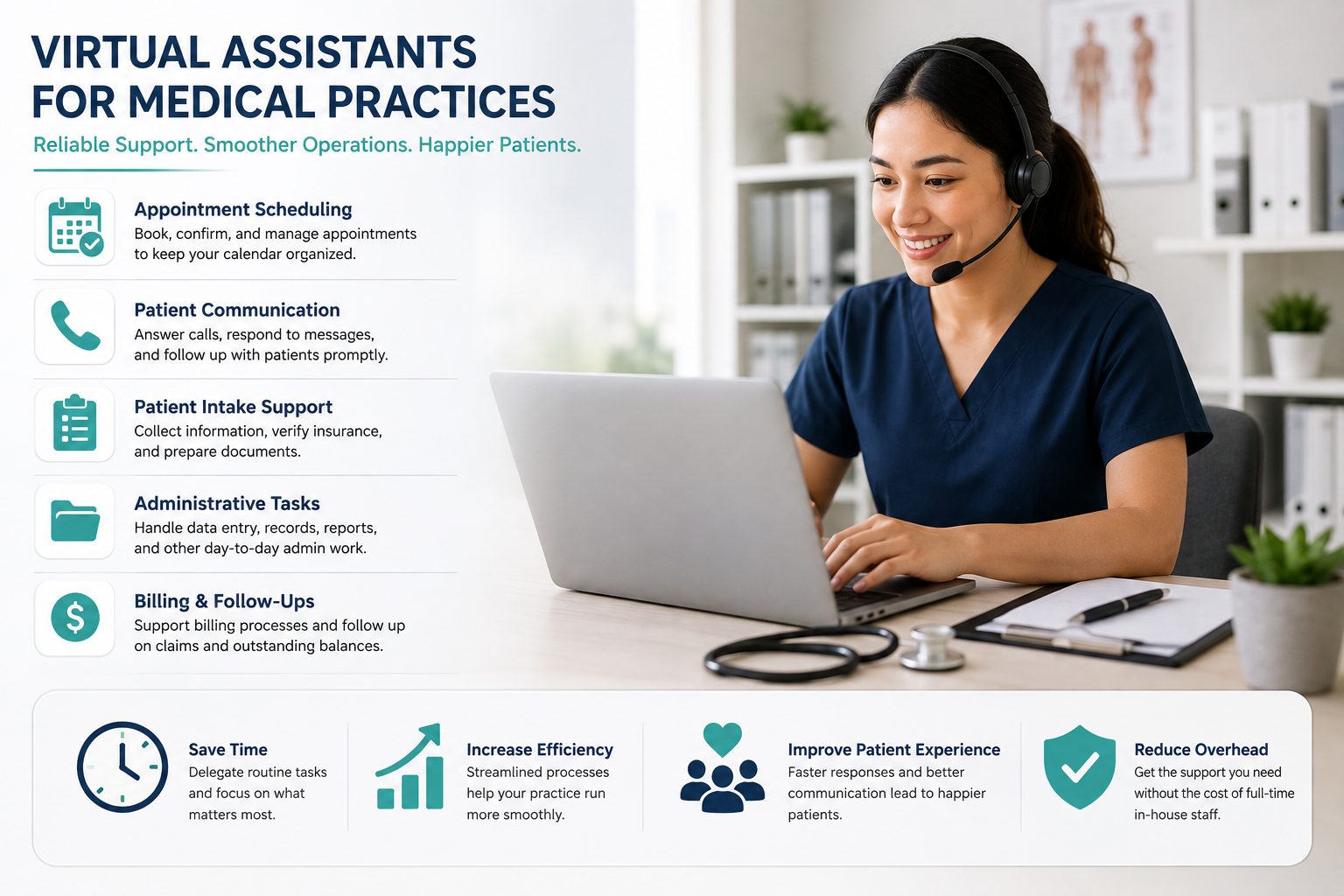
A virtual assistant can provide remote support for many non-clinical tasks. Depending on the practice and the assistant's training, this can include appointment scheduling, patient communication, administrative support, data entry, insurance-related administrative work, and other repetitive tasks. The goal is not to replace medical professionals. Instead, a virtual assistant can take care of appropriate support work so the in-house team has more time for patients and important practice responsibilities.
What Is a Medical Virtual Assistant?
A medical virtual assistant is a remote professional who supports a healthcare practice with administrative or other assigned tasks. The role can look different from one practice to another.
A small private practice may need help answering calls and managing appointments. A larger clinic may need support with patient intake, insurance verification, records, billing follow-ups, or other administrative workflows. Some medical virtual assistants have experience with healthcare systems and terminology. Others may focus mainly on general administrative work.
Before hiring one, a practice should clearly define the tasks, systems, level of healthcare experience, and access to patient information that the role will require.
1. Managing Appointment Scheduling
Appointment scheduling is one of the most common areas where a virtual assistant can help. Medical practices receive calls, emails, online requests, cancellations, and rescheduling requests throughout the day. When the front desk is already busy, some patients may have to wait for a response.
A virtual assistant can help manage the scheduling process by:
- Booking appointments
- Confirming upcoming appointments
- Sending approved reminders
- Handling rescheduling requests
- Managing cancellation follow-ups
- Maintaining waitlists
- Contacting patients about available appointment times
- Keeping calendars updated
This can help keep the schedule organized while reducing some of the work handled by the front desk. A VA should follow the practice's scheduling rules rather than making independent decisions about clinical urgency or treatment.
2. Handling Patient Calls and Messages
Phone calls are a major part of daily medical office operations. Patients may call with questions about appointments, forms, office hours, referrals, billing, or other non-clinical matters. Staff may also need to return calls that were missed during busy periods.
A virtual assistant can help manage these communications. For example, the assistant may:
- Answer approved general questions
- Return routine calls
- Take messages
- Send appointment reminders
- Follow up with patients
- Direct messages to the appropriate staff member
- Track unresolved requests
This can make it easier for the practice to keep communication moving. There should also be a clear escalation process. A virtual assistant should know which questions can be answered directly and which must be sent to a nurse, physician, office manager, or another qualified person.
3. Supporting New Patient Intake
New patients often have several steps to complete before their first appointment. Forms may need to be collected, demographic information entered, appointments confirmed, and insurance information reviewed.
A virtual assistant can help organize these administrative steps. Depending on the practice's workflow, the VA may:
- Send new-patient instructions
- Follow up on missing forms
- Enter approved information into the practice system
- Confirm appointment details
- Organize intake documents
- Track whether required information has been received
This can help prevent incomplete paperwork from slowing down the patient experience. The practice should provide clear instructions about what information the VA is allowed to handle and how it must be stored and communicated.
4. Helping With Insurance Verification
Insurance-related administrative work can take a significant amount of time. Before an appointment, practices may need to verify coverage, collect information, or identify missing details.
A trained virtual assistant may be able to support parts of this process, such as:
- Checking insurance information
- Verifying eligibility through approved systems
- Updating patient records
- Following up on missing information
- Organizing verification results
- Communicating administrative updates to the appropriate team member
The exact responsibilities depend on the practice, payer requirements, software, and the assistant's training. Insurance verification should be treated as an administrative workflow, not as an opportunity for a VA to provide patients with financial or medical advice beyond their assigned responsibilities.
5. Organizing Medical Records and Data
Medical practices work with a large amount of information every day. Patient records, forms, referrals, messages, appointments, and other documents need to be entered and organized correctly.
A virtual assistant can support appropriate data-management tasks, including:
- Data entry
- Updating approved patient information
- Organizing documents
- Uploading files into approved systems
- Reviewing records for missing administrative information
- Maintaining spreadsheets or reports
- Organizing digital files
Accuracy is especially important in healthcare. A practice should provide training and quality checks for any VA who works with patient information. Access should also be limited to the systems and information the assistant actually needs for the assigned work.
6. Supporting Billing and Administrative Follow-Up
Medical billing involves many detailed processes, and administrative follow-up can take time away from other practice responsibilities.
Depending on their training and the practice's requirements, a virtual assistant may help with administrative billing tasks such as:
- Checking claim status
- Following up on outstanding information
- Organizing billing records
- Updating internal tracking sheets
- Contacting patients about approved billing communications
- Routing billing questions to the appropriate staff member
- Tracking unresolved billing issues
Some practices may also use specialized billing professionals for more complex work. The important point is to match the assistant's responsibilities with their experience. Billing tasks that require specialized knowledge should be assigned to someone properly trained for that work.
7. Managing Referral Follow-Ups
Referrals can involve multiple steps. A patient may need to be referred to another provider, diagnostic facility, or specialist. Someone then needs to track whether the referral was received and whether the next step has been completed.
A virtual assistant can help with administrative follow-up. They may:
- Track referral status
- Contact offices using approved procedures
- Organize referral information
- Follow up on missing documents
- Update internal records
- Notify the appropriate practice staff about unresolved referrals
This gives the practice a clearer view of outstanding administrative tasks.
8. Helping With Patient Follow-Ups
Patient follow-up does not always require a clinical conversation. Some follow-ups are administrative, such as appointment reminders, recall scheduling, missing paperwork, or checking whether a patient completed an administrative step.
A virtual assistant can manage these routine communications using scripts and procedures provided by the practice. For example, a VA may help contact patients who need to schedule their next appointment or remind them about paperwork.
For any message involving medical advice, symptoms, treatment decisions, or clinical questions, the VA should follow the practice's escalation process rather than trying to answer independently.
9. Supporting the Front Desk From Behind the Scenes
One of the biggest benefits of a virtual assistant is that they can support the front desk without physically sitting at the front desk. While an in-office employee is helping a patient check in, answering a phone call, or dealing with an unexpected issue, a remote VA may work on other assigned tasks.
This creates another layer of support. For example, the VA could work on:
- Appointment confirmations
- Call-backs
- Data entry
- Document organization
- Patient follow-ups
- Scheduling
- Administrative reports
This can help the in-house team spend less time switching between different tasks.
10. Helping With Practice Administration
Not every task in a medical practice involves patients directly. There is also general administrative work that keeps the business organized.
A virtual assistant may help with:
- Calendar management
- Email organization
- Spreadsheet updates
- Document preparation
- Research
- Data entry
- Internal reports
- File organization
- Basic administrative coordination
These tasks may seem small individually, but they can take up a large part of a workday when combined. Delegating appropriate administrative work can give practice owners and managers more time to focus on operations and patient care.
Why Medical Practices Are Considering Virtual Assistants
The main advantage of a virtual assistant is not simply having another person available. It is about creating a better division of work.
Doctors and clinical staff need to focus on patient care and responsibilities that require their professional knowledge. Office managers need to oversee operations. Front-desk staff need to support patients who are physically in the office. At the same time, many administrative tasks are repetitive and follow established processes. Those tasks can sometimes be handled remotely.
A virtual assistant can become an additional layer of support, helping the practice keep routine work moving without requiring every task to be handled by the same person.
What About HIPAA and Patient Information?
This is one of the most important questions a medical practice should ask before hiring a virtual assistant. HIPAA protects certain individually identifiable health information held by covered entities and their business associates. When an outside person or organization performs certain services for a covered entity and has access to protected health information, the relationship may fall under the HIPAA business associate rules. HHS explains that services such as administrative support, billing, practice management, and other functions can qualify when they involve protected health information.
For these situations, HHS generally requires the covered entity and business associate to have a written agreement that establishes permitted uses of protected health information and requires appropriate safeguards. This means a medical practice should not simply give a general virtual assistant access to patient information without first reviewing the relationship, systems, permissions, contracts, and security requirements.
Before hiring a VA, practices should consider questions such as:
- Will the assistant have access to protected health information?
- What systems will the assistant use?
- Is the assistant or staffing company a business associate when required?
- Is a Business Associate Agreement needed?
- What security controls are in place?
- What information does the assistant actually need?
- What happens if there is a suspected privacy or security incident?
HIPAA requirements can depend on the specific arrangement, so practices should get appropriate professional guidance when needed.
How to Successfully Work With a Medical Virtual Assistant

Hiring a VA is only the beginning. The assistant needs clear instructions and defined responsibilities to become a useful part of the practice. Start by identifying the tasks that take the most time. Look for work that is repetitive, follows a clear process, and does not require a clinical decision. Then create simple procedures.
For example, a scheduling procedure might explain:
- Which appointment types the VA can schedule.
- Which appointment types require staff approval.
- How to handle cancellations.
- How to manage the waitlist.
- When to escalate a patient request.
- How to document the interaction.
The same approach can be used for patient calls, administrative follow-ups, records, and other tasks. It is also helpful to start with a smaller group of responsibilities. Once the VA understands the practice's systems and expectations, additional tasks can be added.
Who Can Benefit From a Medical Virtual Assistant?
A virtual assistant may be useful for many types of practices, including:
- Solo medical practices
- Primary care offices
- Specialty practices
- Dental practices
- Chiropractic offices
- Mental health practices
- Therapy practices
- Private clinics
- Multi-provider practices
The right role depends on the practice. A solo doctor may primarily need scheduling and administrative help. A larger practice may need separate support for patient communication, billing administration, referrals, or data management. The important part is to match the assistant's skills to the actual needs of the practice.
When a Virtual Assistant May Not Be the Right Fit
A VA is not the answer to every staffing problem. Some responsibilities require someone physically present in the office. Clinical care, physical examinations, certain procedures, and other hands-on responsibilities cannot simply be moved to a remote assistant.
A VA also should not be expected to make medical decisions or provide clinical advice without the appropriate qualifications and role. The best use of a virtual assistant is usually focused on appropriate support work that can be performed remotely and managed through clear processes.
A Smarter Way to Handle Practice Administration
Medical practices do not have to choose between doing everything in-house and outsourcing everything. There is a middle ground. A practice can keep patient care and important clinical responsibilities with its core team while delegating selected administrative tasks to a remote professional. This approach can be especially useful when the practice has grown but is not ready to build a larger administrative department.
The first step is simply to identify where time is being lost. Which tasks are repeated every day? Which calls could be handled by someone else? Which administrative work keeps getting pushed to the end of the day?
Those questions can help a practice determine whether a virtual assistant makes sense.
How Virtual Staff Labs Can Help With Virtual Staffing
Finding the right remote support does not have to mean searching through dozens of freelancer profiles. Virtual Staff Labs connects businesses with vetted medical virtual assistants and provides support with recruiting, matching, onboarding, and ongoing assistance. Its services include administrative support, customer service, and other specialized virtual staffing roles.
For a medical practice considering a virtual assistant, the key is to clearly explain the role, required experience, software, working hours, and level of access involved. If the position will involve protected health information, the practice should also discuss HIPAA-related requirements and determine whether a business associate relationship and BAA are required before providing access to PHI. Virtual Staff Labs can be considered as a staffing option for practices that need remote administrative support, but the specific healthcare compliance requirements should be confirmed for the role and arrangement before work involving PHI begins.
A virtual assistant does not have to take over an entire medical office. Even a focused role supporting scheduling, administrative work, communication, or other appropriate tasks can make a difference. For practices that are spending too much time on routine administrative work, the right virtual assistant may provide the extra support needed to keep operations organized while allowing the in-house team to focus on what matters most: taking care of patients.